

Overview
Ultrasonic Testing (UT) is one of the main Non-Destructive Testing (NDT) services provided by ARI. Using a probe comprised of a piezoelectric element sends ultrasonic waves through the material being tested. This produces an A-Scan, which shows how the waves travel. Our Certified NDT technicians then interpret the A-Scan to detect flaws, measure thickness, assess welds and other structural components to determine the material’s condition.
Ultrasonic testing services are utilised across various industries, including mining, manufacturing, oil and gas, and power generation, to inspect a wide range of materials.
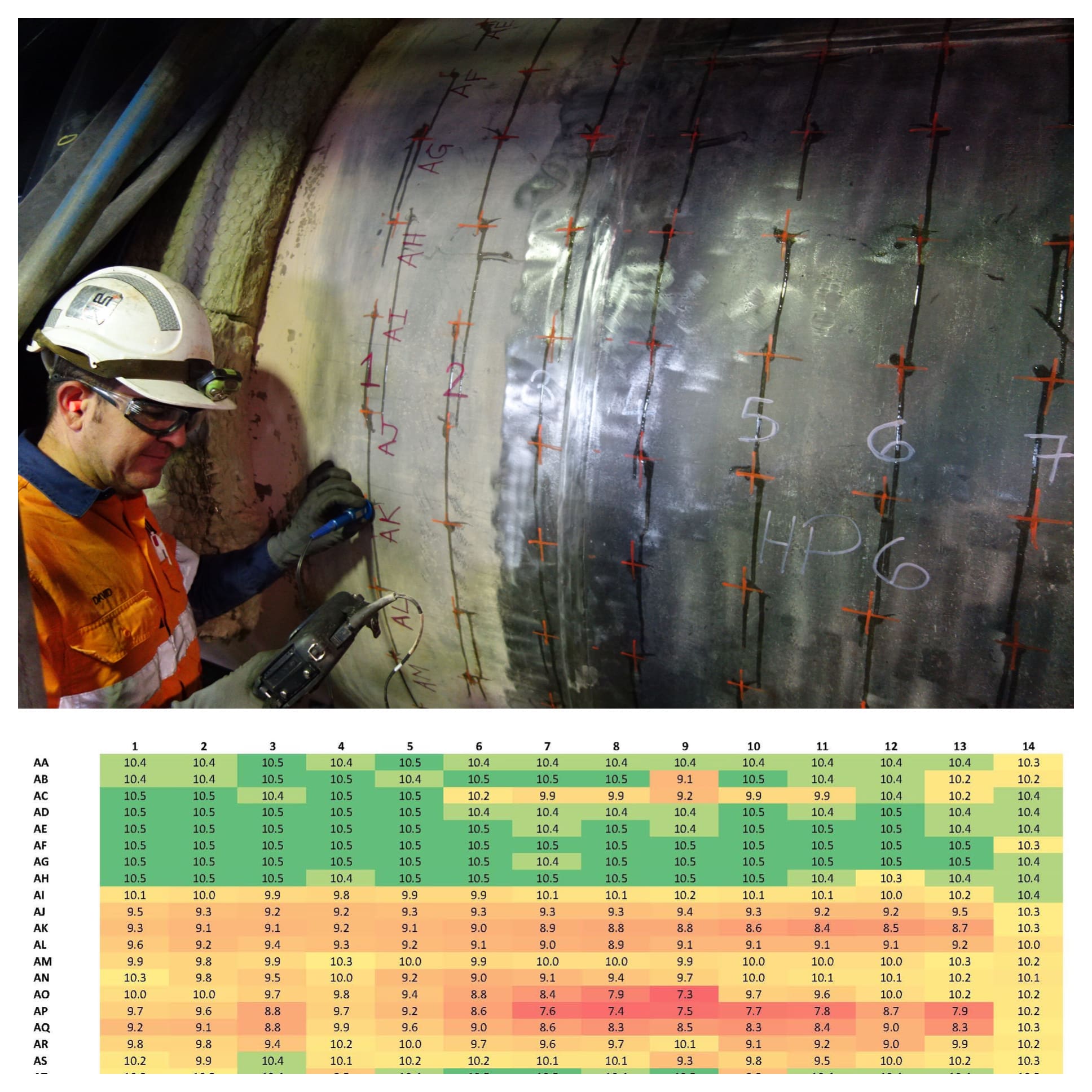
How Ultrasonic Testing Works
Ultrasonic Testing sends high-frequency sound waves into the component being inspected. An A-Scan is created, which our certified technicians will review to determine the condition of the material. It is a cost-effective and fast inspection technique that determines the acceptance or rejection of a test object based on a reference code or standard.
Ultrasonic Testing Applications
Ultrasonic Testing is versatile and used for a wide range of inspections. Common applications include:
- Thickness Measurement
- Weld Inspection
- Ball Stud Testing
- Lamination and Corrosion Detection
Our ultrasonic testing services can be tailored to meet the specific needs of each project.
To learn more about our range of NDT services, visit our Non-Destructive Testing Services page, or our Advanced NDT services for specialised inspections and techniques.
Advantages of Ultrasonic Testing
- High Sensitivity: Ultrasonic testing can detect extremely small flaws or defects in materials, making it ideal for early detection of potential problems.
- Depth of Penetration: Ultrasonic waves can penetrate materials deeply, allowing for the inspection of thick sections and complex geometries.
- Accurate Sizing of Defects: This method can provide accurate measurements of the size, shape, and orientation of detected flaws.
- Non-Hazardous: Unlike radiography, ultrasonic testing does not use ionising radiation, making it safer for operators and the environment.
- Instant Results: The results are immediate, which is beneficial for quick decision-making in industrial processes.
- Portability: Modern ultrasonic NDT equipment is often portable and can be used in a variety of field conditions.
- Versatility: It can be applied to a wide range of materials, including metals, plastics, composites, and ceramics.
- Minimal Preparation: The test piece usually requires minimal surface preparation compared to other NDT methods.
Considersations
- Skill-Dependent: It requires a high level of skill and experience to interpret the results accurately.
- Surface Access Required: Access to both sides of the sample may be necessary, which can be a limitation in some applications.
- Couplant Needed: Most ultrasonic techniques require a couplant to facilitate the transmission of sound waves, which can be messy or impractical in some situations.
- Limited on Certain Materials: Materials that are highly porous or have coarse grain structures (like cast iron) can scatter the sound waves, making it difficult to get accurate readings.
- Difficulty with Complex Geometries: Components with complex shapes or surfaces can pose challenges in terms of probe placement and interpretation of results.
Other ARI Certified NDT Methods
We offer a full range of Certified NDT services. Alongside Ultrasonic Testing, our expert team provides a variety of inspection techniques tailored for your specific project, view our full range of services:
Why Choose ARI
Each inspection is tailored specifically to your needs and project. Our certified NDT technicians take care and complete every inspection with care.
ARI can provide a complete range of NDT Services. With certified testing technicians in Perth, Adelaide, Melbourne, Port Hedland and Bunbury, we determine which option is best for your NDT needs.